
Fascial Manipulation for Internal Dysfunctions
An important part of Stecco's approach to fascia — fascial manipulations for internal, visceral dysfunctions. I think such a well-developed and complex method deserves a separate mention. Although we work with fascial restrictions, especially centers of fusion, just as in the somatic part, both the diagnostic and therapeutic models differ significantly.
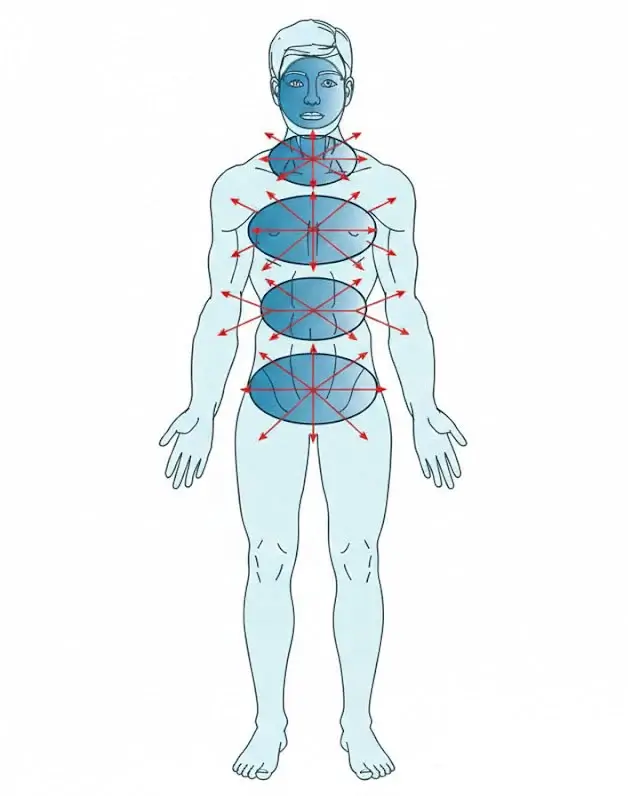 Fascial Manipulation according to Stecco is not merely work with membranes. It is a view of fascia as an active system that coordinates both movement and internal homeostasis. The direction for internal dysfunctions (FMID) is a logical development of this idea: we act not on the organ itself, but on the fascial "container" of the trunk, restoring the conditions for its normal function.
Luigi Stecco began his research in the early 1970s, observing folk bone-setters and studying osteopathy, acupuncture, and trigger points. His first book was published in 1987, and by 2002 he had formulated the key idea: visceral fascia and the autonomic nervous system are inseparably connected. This became the foundation of the third level of training — FMID.
Core Principles
- Indirect action. The therapist does not work directly with organs but manipulates the fasciae of the trunk walls — abdominal, thoracic, cervical. This eliminates mechanical interference and restores the "vital space" necessary for normal peristalsis and organ motility.
- Tensegrity model. Each body segment is considered as a cylinder with an elastic anterior wall and a rigid posterior wall. Tension within it is distributed along three directions (tensors): antero-posterior (AP), lateral (LL), and oblique (OB).
- Connection with the autonomic nervous system (ANS). Intramural ganglia controlling organ function are embedded in fascial layers and are activated upon their stretching. Restoring fascial gliding normalizes the signals directed to the organs.
- Densification versus gliding. The cause of dysfunctions is "densification" — a thickening of hyaluronic acid in the fascia, when it transforms from a fluid state (sol) into a viscous one (gel), disrupting the gliding of layers.
Osteopathic Mentor - mentorship and courses
Indications and Practice
The method is especially valuable where examinations find nothing, yet the patient continues to complain. Bloating, heartburn, constipation, chronic cough, painful menstruation, edema — all of this is that very "grey zone" where conventional medicine often throws up its hands. And here I regularly see how work with points on the anterior abdominal wall resolves symptoms that for years were attributed to "psychosomatics" or "individual constitution."
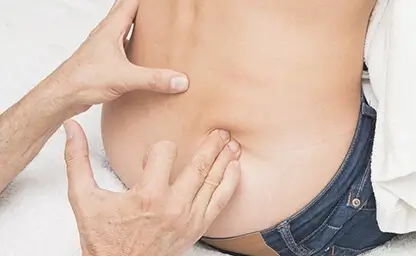
Diagnosis is built on palpation. We look for centers of fusion (CF): specific densifications with sharp, "needle-like" pain. Then — deep friction, until local heat appears. Not the force of pressure, but the precision of point selection. Manus sapiens potens est — the knowing hand is powerful. This, perhaps, best describes the essence of the approach.
As for the difference between fascial manipulations for internal dysfunctions and visceral manipulations according to Barral, they look nothing alike externally. Nevertheless, both methods are needed, they simply act on different links in the chains of dysfunctions. What personally interests me most about the Stecco method is the holistic approach. For example, I regularly see in practice unilateral painful densifications in the abdomen and on the same side in the back (anchors), or in the tensors of the related limbs.
☛ Osteopathic Visceral Manipulation Techniques.
☛ Chapman Points - Neurolymphatic Reflex Massage.
New on Instagram:
Treatment techniques

Online consultancy

Quick test
About me